
In short
Website monetization works best when the revenue model matches why visitors arrive. Use display ads for broad informational traffic, affiliate links for product-research intent, owned offers for a specific problem, subscriptions for recurring value, sponsorships for a defined audience, and services when each qualified lead is worth more than thousands of page views.
Table of contents
- Which revenue model should you choose first?
- Can you monetize a website with low traffic?
- How do you monetize a website with display ads?
- When does affiliate marketing make more sense than ads?
- When should you sell a product, paid content, or membership?
- When should you use sponsorships, direct advertising, or services?
- How do you combine revenue streams without hurting the site?
- How much money can a website make per 1,000 views?
- What should you measure after monetization goes live?
- What else do website owners ask about monetization?
A website is not monetized simply because an ad, product, or payment button has been added. The site becomes monetized when the right visitor sees a relevant offer, takes a measurable action, and produces more revenue than the model costs to operate.
That distinction matters. A small site with strong commercial intent may earn more from one service inquiry than from thousands of display-ad impressions, while a large informational publisher may need a low-friction model that earns from readers who are not ready to buy anything.
Which revenue model should you choose first?
Choose the model that fits the visitor's reason for opening the page, not the model that looks easiest to install. Traffic volume matters, but intent, contribution per conversion, and operating workload usually determine which option deserves priority.
| Revenue model | Best fit | Traffic dependence | Potential margin | Ongoing effort | First proof to seek |
|---|---|---|---|---|---|
| Display ads | Broad informational content | High | Low per visit | Low to medium | Stable page RPM without damaged engagement |
| Affiliate commissions | Reviews, comparisons, and buying questions | Medium | Medium | Medium | Qualified outbound clicks and tracked sales |
| Digital products or paid content | A repeatable problem with a reusable solution | Low to medium | High before support costs | Medium | Visitors repeatedly asking for the same solution |
| Memberships or subscriptions | Value that can be renewed every month | Medium | High before delivery costs | High | A loyal audience returning for ongoing help |
| Sponsorships or direct advertising | A defined niche attractive to specific advertisers | Medium | High per agreement | High sales effort | Advertiser interest in the audience itself |
| Services or qualified leads | A costly problem requiring individual help | Low | High per conversion | High delivery effort | Relevant inquiries from existing content |
The ratings are relative decision aids, not earnings promises. A service can produce substantial revenue from a few clients but require hours of delivery, while display ads can operate with less daily involvement but usually need more page views.
What is the visitor trying to accomplish?
Informational visitors want an answer. Display ads fit this behavior because readers can consume the answer without buying, registering, or leaving the page.
Commercial visitors are comparing options or checking whether a purchase is right for them. Affiliate recommendations, an owned product, or a service inquiry may fit better because the visitor is already moving toward a decision.
A page should therefore be monetized according to its intent. A tutorial, comparison page, calculator, and consulting page can belong to the same website while using different primary revenue models.
How much is one useful action worth?
Estimate contribution rather than headline revenue. A product that sells for $50 but costs $20 in processing, refunds, support, and delivery contributes less than $50 to the business.
The same principle applies to services. A lead is valuable only when it is relevant, reachable, and likely to become profitable work. Counting every form submission as equal can make a weak service funnel look healthier than it is.
How much recurring work can you support?
Display ads need monitoring, but they do not require the publisher to fulfil every transaction. Services, sponsorships, and memberships require more communication, delivery, administration, or regular production.
Choose a model the business can still support when traffic doubles. A membership that promises ongoing value is not passive simply because billing recurs automatically.
Does the model fit the page naturally?
Readers should be able to explain why the offer appeared. A hosting comparison can support relevant tracked recommendations, while a general informational article may be better suited to ads or a related owned resource.
This is also why content designed to earn starts with the page's business purpose instead of adding random links after publication.
✅ A practical starting rule is to choose one primary model for each page and one primary model for the website as a whole.
Can you monetize a website with low traffic?
Yes, a low-traffic website can be monetized, but the model must extract value from relevance rather than volume. Display ads may produce limited revenue at low volume, while a relevant product, service, lead, or affiliate conversion can be worth considerably more per visitor.
Two simple formulas clarify the choice:
Display-ad revenue = page views ÷ 1,000 × page RPM
Conversion revenue = qualified visitors × conversion rate × contribution per conversion
A site with 2,000 monthly users and mostly broad informational visits is unlikely to create large display-ad income immediately. The same number of visitors could still support a specialist service or narrowly relevant product if some visitors have a costly, urgent problem.
Low traffic creates three priorities:
- Protect the traffic already earned. Do not bury useful content under ads, pop-ups, or competing offers.
- Identify pages with commercial intent. Search queries containing terms such as cost, best, comparison, service, course, template, or solution may indicate a decision is closer, although the page must still satisfy the actual question.
- Continue building qualified discovery. Sustainable search engine optimization can expand the number of relevant visitors instead of merely chasing a larger unqualified audience.
A site does not need to wait for a magical traffic threshold before testing monetization. It does need enough visits and actions to distinguish a repeatable signal from a one-off result.
How do you monetize a website with display ads?
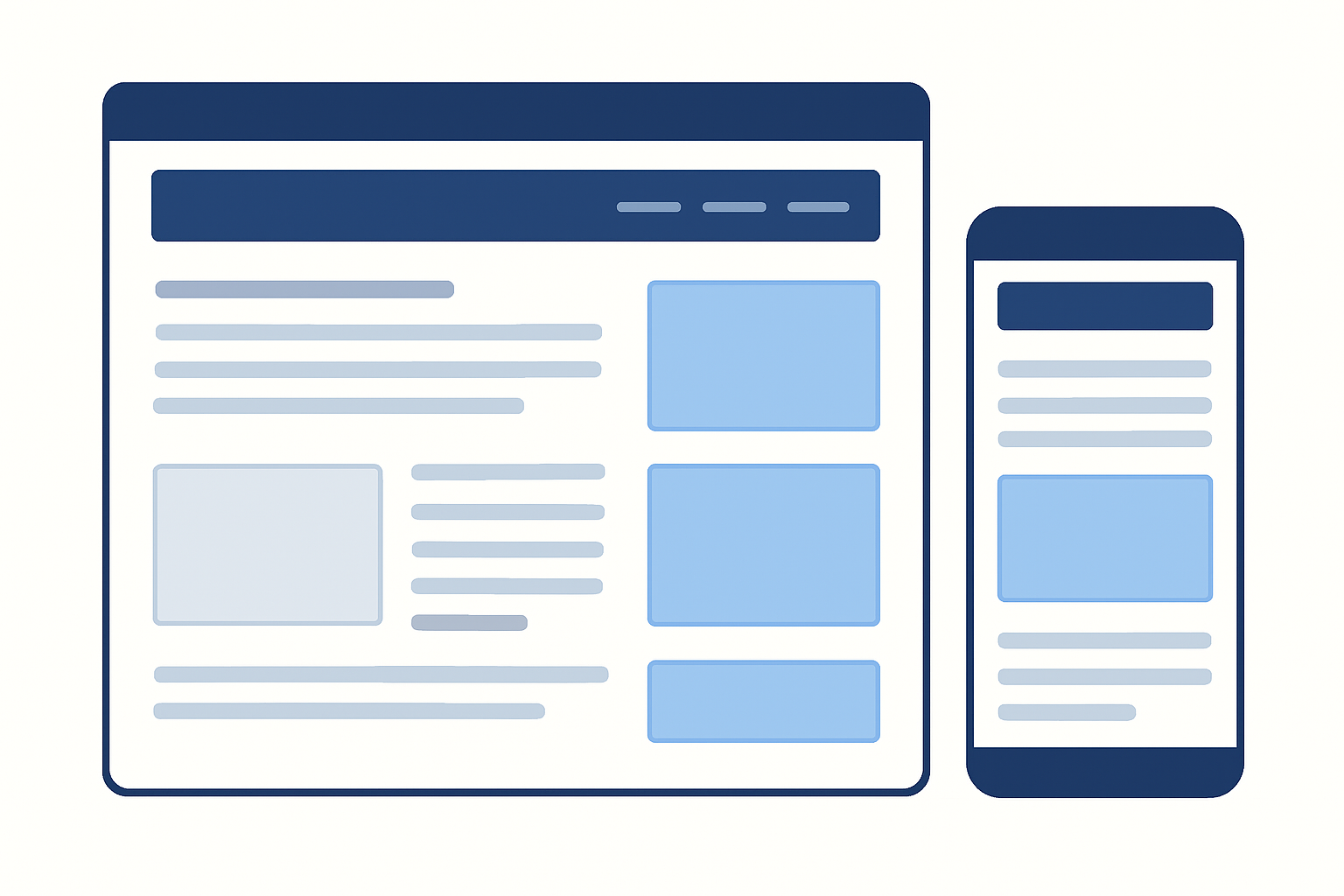
To monetize a website with display ads, confirm eligibility, record a baseline, connect the site, configure consent, choose conservative placements, and measure page RPM alongside user experience. As of August 31, 2026, publishers also need to account for current consent-framework and invalid-traffic requirements before treating the installation as complete.
1. Does the site meet the basic requirements?
The first website monetization requirements are control, original content, policy compliance, and a usable site. Google's current AdSense eligibility requirements say an applicant must have their own policy-compliant content, be at least 18, and be able to access the site's HTML source code. The published eligibility page does not state a universal minimum page-view requirement. (support.google.com)
Approval is not the same as revenue. Thin pages, copied material, unfinished navigation, or traffic with little advertiser value can remain poor business assets even if an ad platform accepts the site.
2. What should you record before installing ads?
Create a baseline for the previous period using the same analytics definitions you will use later. At minimum, record:
- Page views, sessions, and pages per session.
- Traffic by country and device.
- The most-visited pages and page templates.
- Current engagement or conversion events.
- Largest Contentful Paint, Interaction to Next Paint, and Cumulative Layout Shift.
Without a baseline, higher revenue can hide a decline in reader experience or an unrelated traffic increase. The useful question is not merely whether revenue rose, but what happened to revenue per unit of comparable traffic.
3. How do you connect the site correctly?
Follow the platform's current verification process rather than copying code from an old tutorial. Google's site connection instructions currently support an ad-code snippet, an ads.txt entry, or a verification meta tag, depending on the setup. (support.google.com)
Place the supplied identifier exactly as issued and confirm it on the live domain. If ads.txt is used, it belongs at the root domain and must contain the correct publisher identifier. An incorrect identifier can stop eligible auctions from running on requests where the file is present, according to Google's ads.txt guidance. (support.google.com)
4. What consent setup is needed?
Consent requirements depend on the visitor's location, the technologies used, and applicable law. For personalized ads served through Google's publisher products in the European Economic Area, the United Kingdom, and Switzerland, Google requires a certified consent management platform integrated with the IAB Transparency and Consent Framework. (support.google.com)
The dates matter. Google's publisher documentation says the certified-CMP requirement took effect for the EEA and UK on January 16, 2024, and for Switzerland on July 31, 2024. Its integration documentation also identifies March 1, 2026 as the mandatory transition deadline for TCF v2.3. (support.google.com)
A platform-certified consent tool does not automatically prove full compliance with every privacy law. Google explicitly says its certification focuses on framework criteria rather than complete legal compliance, so publishers should assess the jurisdictions from which they receive visitors.
5. Should you start with automatic or manual placements?
Automatic placement is faster to test. Google's Auto ads documentation says the system analyzes page structure, content, and existing ads before selecting eligible placements, with controls for formats and locations. (support.google.com)
Manual units offer more deliberate control over spacing and page hierarchy. A practical starting point is to protect the introduction, navigation, forms, tables, interactive tools, and primary conversion areas, then test ads at natural content breaks.
Do not activate every available format at once. Starting conservatively makes it easier to identify which change affected revenue, layout stability, engagement, or complaints.
6. How do you protect policy compliance and user experience?
Never click live ads on your own site, ask other people to click them, buy traffic designed to create impressions, or place ads where they can be mistaken for menus and download buttons. Google's invalid-traffic guidance treats artificial and accidental clicks as invalid, while its current policies prohibit encouraging clicks and deceptive placements. (support.google.com)
Advertising and paid promotional material should not overwhelm publisher content. Google identifies pages with more ads or paid promotion than publisher content as a common policy problem. (support.google.com)
Performance needs the same attention. Google's current Core Web Vitals thresholds define good performance as LCP within 2.5 seconds, INP below 200 milliseconds, and CLS below 0.1, assessed at the 75th percentile across mobile and desktop. (developers.google.com)
Ads can affect all three. Reserve space for ad units to reduce layout shifts, review the scripts loaded on each template, and test on real mobile devices rather than relying only on a desktop preview.
7. How do you test whether a change worked?
Google defines page RPM as estimated earnings divided by page views, multiplied by 1,000. Page RPM makes periods with different traffic levels easier to compare, but it remains an estimated rate rather than a promise of future earnings. (support.google.com)
Change one major variable at a time. Compare the same page types, devices, traffic regions, and normal weekly patterns before deciding that an ad position or format is better.
Track total revenue, page RPM, engagement, Core Web Vitals, and conversion losses together. The highest ad RPM is not automatically the best outcome if it reduces traffic, product sales, returning visitors, or trust.
When does affiliate marketing make more sense than ads?
Affiliate monetization makes more sense when visitors are actively researching a product or service and a useful recommendation can move the decision forward. Display ads fit broad attention, while affiliate revenue depends on qualified clicks, merchant tracking, conversion, and the commission terms in effect.
Good candidates include comparisons, alternatives, implementation tutorials, product roundups, and answers to pre-purchase questions. The recommendation must still help the reader if no purchase occurs.
Affiliate income is less dependent on raw page-view volume than display advertising, but it is more dependent on intent and attribution. Revenue can disappear when a program changes its commission, tracking window, eligible products, or participation terms.
Disclosure is not optional where a material connection could affect how readers evaluate a recommendation. In the United States, the Federal Trade Commission's revised 2023 guidance says affiliate relationships should be disclosed clearly and conspicuously, close enough to the recommendation and link for readers to make the connection. (ftc.gov)
Publishers should also configure commercial links appropriately. Google Search Central recommends marking affiliate and paid links with rel='sponsored', with nofollow still accepted for paid links. (developers.google.com)
Do not add an affiliate link merely because the page ranks. If the reader arrived for a definition or quick factual answer, an unrelated recommendation weakens the page instead of monetizing it intelligently.
When should you sell a product, paid content, or membership?

Sell an owned offer when the audience has a repeatable problem the website can solve more completely than a free article. Choose a one-time product for a defined outcome, paid content for protected information, and a membership only when the value genuinely continues after the first payment.
When does a one-time product fit?
A digital product fits when many visitors need the same deliverable or process. Examples include a course, report, template, calculator, dataset, guide, or licensed asset, provided the creator has the right to sell it and can support what is promised.
A product can earn more per conversion than an ad impression, but it introduces checkout management, customer questions, refund handling, updates, and product-quality expectations.
When does paid content fit?
Paid content works when the protected material is meaningfully different from the free material. Depth, original data, specialist analysis, convenience, or access can justify payment; simply hiding an ordinary article behind a checkout rarely creates a compelling offer.
Test demand before building a large library. Repeated questions, requests for implementation help, or strong engagement with a narrow topic can reveal where a paid resource may be useful.
When does a membership fit?
A membership needs recurring delivery. That may come from frequently updated material, an active community, continuing tools, accountability, live access, or another benefit that remains useful over time.
Recurring billing without recurring value creates cancellations and support work. Estimate revenue after platform fees, refunds, ongoing production, moderation, and member support rather than treating every subscription payment as profit.
When should you use sponsorships, direct advertising, or services?
Use sponsorships or direct advertising when a clearly defined audience is valuable to a specific advertiser, and use services when the reader's problem requires customized work. These models can operate with less traffic than automated display advertising, but they demand sales, qualification, negotiation, and delivery.
A sponsorship sells access to audience attention, not simply empty space on a page. A credible proposal needs accurate audience data, suitable placements, a clear schedule, deliverables, and boundaries around editorial control.
Direct advertising can produce more revenue per placement than an automated auction, but the publisher must find advertisers, agree on terms, deliver the placement, invoice, report results, and replace the advertiser when the agreement ends. Unsold inventory produces nothing.
Sponsored content also needs clear labeling. In the United States, FTC guidance applies when payment or another material connection could influence how an endorsement is evaluated, and paid outbound links should be technically qualified for search engines. (ftc.gov)
Services take the opposite trade-off. They may monetize a small number of high-intent visitors, but the revenue is connected to human capacity. A service business should track qualified inquiries, close rate, contribution per client, and delivery time rather than celebrating every lead equally.
How do you combine revenue streams without hurting the site?
Combine revenue streams page by page rather than placing every offer on every page. A good monetization stack gives each page one primary action, allows compatible secondary revenue, and removes elements that compete with the visitor's immediate task.
A practical allocation may look like this:
- Informational tutorials use display ads as the primary model.
- Product comparisons use relevant affiliate recommendations.
- Problem-aware pages introduce an owned resource or service.
- Loyal returning visitors receive an invitation to recurring value.
- A defined niche audience supports carefully selected sponsorship inventory.
These models can coexist across the site. They should not all demand attention inside the same paragraph.
Start with the model that best matches the largest share of qualified traffic. Add a second stream only where it answers a different reader need or reduces dependence on the first model.
Avoid aggressive overlays that hide content or interrupt visitors before they have received an answer. Google Search Central says intrusive interstitials can frustrate users and make content harder for search engines to understand, recommending smaller banners where a full-screen interruption is not mandatory. (developers.google.com)
Set a hierarchy for every template: content first, primary monetization second, optional secondary offer third. If the hierarchy is not visible in a mobile screenshot, the page probably contains too many competing elements.
How much money can a website make per 1,000 views?
A website has no fixed earnings rate per 1,000 views because revenue depends on the model, audience, page, conversion behavior, and current commercial terms. For display ads, page RPM provides the clearest calculation: estimated earnings divided by page views, multiplied by 1,000.
| Illustrative page RPM | Ad revenue per 1,000 page views | Page views for $100 per day | Page views for $1,000 total |
|---|---|---|---|
| $2 | $2 | 50,000 | 500,000 |
| $5 | $5 | 20,000 | 200,000 |
| $10 | $10 | 10,000 | 100,000 |
| $20 | $20 | 5,000 | 50,000 |
The RPM values are calculation scenarios, not market averages or promised earnings.
The formula for a revenue goal is:
Required page views = target revenue ÷ page RPM × 1,000
At a $5 page RPM, $100 divided by $5 and multiplied by 1,000 equals 20,000 page views. At a $20 page RPM, the same target requires 5,000 page views.
Actual page RPM can change over time, so use the site's own reporting instead of adopting a number from another publisher. Also confirm whether a dashboard reports revenue per page view, ad impression, session, or another unit before comparing figures.
Affiliate, product, membership, sponsorship, and service revenue do not map cleanly to page views. For those models, calculate revenue per 1,000 sessions as an internal comparison metric, then break the result into click rate, conversion rate, contribution per conversion, and refunds or delivery costs.
What should you measure after monetization goes live?
Measure revenue and reader outcomes together so a short-term increase does not hide a weaker website. The core dashboard should connect money to page type, traffic source, visitor location, device, conversions, and user-experience changes.
Track these metrics consistently:
- Total revenue: The amount generated during the reporting period.
- Page RPM: Estimated display-ad earnings per 1,000 page views.
- Revenue per 1,000 sessions: A common internal denominator for comparing different models.
- Conversion rate: The share of eligible visitors completing the intended action.
- Contribution per conversion: Revenue left after variable delivery, processing, refunds, commissions, or fulfilment costs.
- Revenue by page and template: The content and layouts producing the business result.
- Traffic quality: Geography, device, source, returning visitors, and suspicious activity.
- Reader experience: Core Web Vitals, engagement, complaints, and conversion losses after layout changes.
Segment before drawing conclusions. A higher site-wide RPM may result from a temporary change in traffic geography or page mix rather than a better ad placement.
Review pages with traffic but no meaningful revenue signal. Some should remain purely informational because they build trust or internal pathways, while others may need a better-matched offer. The aim is not to force money from every visit; it is to learn which pages contribute to a sustainable publishing business.
What else do website owners ask about monetization?
The following questions focus on the traffic and earnings calculations website owners commonly need before choosing a model. Each answer uses transparent assumptions rather than presenting an income estimate as a guarantee.
How much does a website make per 1,000 views?
A website does not have a fixed income per 1,000 views. For display ads, use page RPM: estimated earnings divided by page views, multiplied by 1,000. A $5 page RPM means 1,000 page views produced about $5 in estimated ad earnings, while affiliate or product revenue depends on conversions rather than views. (support.google.com)
How do I make $100 per day with Google AdSense?
To make $100 per day with Google AdSense, divide $100 by your actual page RPM and multiply by 1,000. At a $5 page RPM, the math requires 20,000 daily page views; at $10, 10,000; at $20, 5,000. Those RPMs are examples, not promised or typical earnings.
Can I monetize a free website?
A free website can be monetized if the hosting platform allows commercial activity and gives you enough control to add the required code, disclosures, or checkout. For AdSense specifically, Google says applicants need policy-compliant original content and access to the site's HTML source, although supported host partners can use their own setup flow. (support.google.com)
How many views do you need to make $1000?
The views needed to make $1,000 depend on revenue per 1,000 page views. At a $5 page RPM, the calculation is 200,000 page views; at $10, 100,000; at $20, 50,000. A product or service site may reach $1,000 with far fewer visits if a small number of visitors convert.
What should you do next?
Start by assigning one primary revenue model to the site's 20 most-visited pages, then record the baseline metric that will prove whether the change works. Do not install six models at once; select the one that matches the dominant visitor intent and make its first test measurable.
If display advertising is the priority, my High CPM Generation Course focuses on higher-value niche selection, premium geographic traffic, page layout, ad placement, and click-through-rate improvement without losing sight of reader experience.
Pick one page template today, record its current traffic and conversion data, and decide what one visitor action should be worth measuring next.